
News & Events
REVIEWS
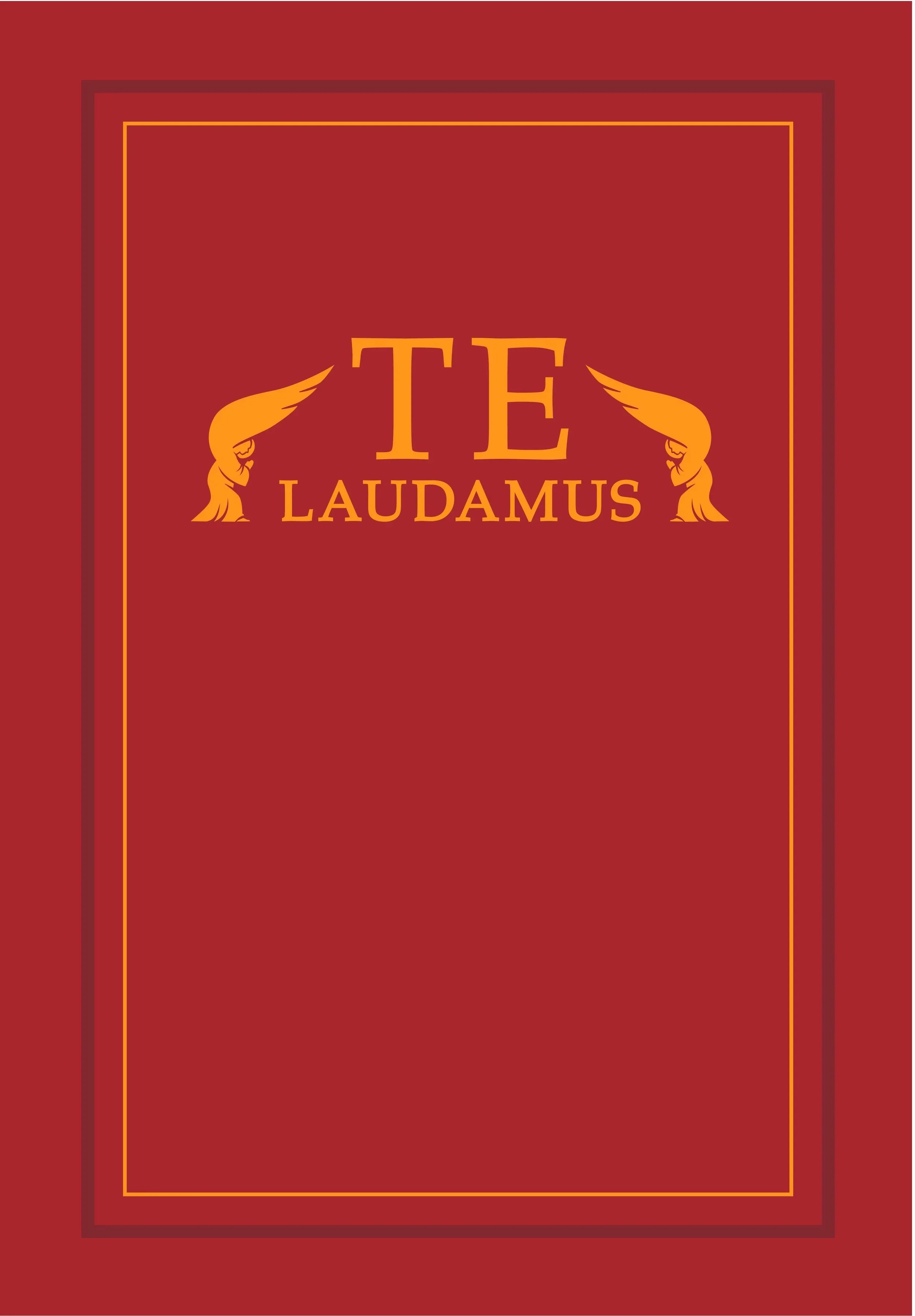
REVIEW OF TE LAUDAMUS
If poetry, music, and art are added ‘extras’ to our existence, nonessential diversions which provide pleasure and distraction in the midst of ‘real life,’ then Christians should ask: why is so much of the Old Testament in verse; for what reason did the Divine Author retain the now-forgotten musical settings of the inspired Psalms; and why did God give so many directives to those artisans, Bezalel and Oholiab, to work with all manner of materials in fashioning the ark, the tabernacle, and the holy vessels?
Truly, man himself is crafted to imitate, to frame, and to enjoy his Creator’s splendid works. The Lord speaks beautifully, and we learn to speak poetically in return. He writes the littlest song of the bluebird and the cosmic music of the revolving galaxies, and so we make music in return. Our Father crafts the mountain ranges and the molecule, and so we draw, paint, and sculpt in return. Chesterton wrote in The Everlasting Man, “Art is the signature of man.” This is because man is made in God’s image, in the image of the Creator. We make art because God made us.
If Te Laudamus is anything in addition to being a valuable resource for God’s worshiping people, it is also a work of art. It marshals poetry, music, and art together in the old way; that is, in the natural, creaturely way Christians used to lovingly craft liturgical and theological works in the Medieval and Renaissance Church. During the nineteenth and twentieth centuries, when nihilism and atheism banished beauty and wreaked aesthetic havoc, book publication often became a mere utilitarian, practical affair. Publishers increasingly dispensed with extra pictures, color printing, and classic features because they were deemed “unnecessary” or even “distracting.” Through the years, hymnals unfortunately became blander and cheaper. If a hymnal had an image, it was a nonessential flourish to fill space, or a simplistic cipher to notify the reader that a new section was beginning.
Not so with Te Laudamus. Though I am not knowledgeable enough to expertly appraise or analyze the musical settings, Gregorian chants, and hymnody of Te Laudamus, I notice immediately that the editors have done a wonderful task in reclamation and retrieval. All 150 Psalms are included. The Psalter is, after all, the hymnbook of the Bible, and reasons for excluding certain Psalms from any hymnal (due to space or other considerations) ultimately are outweighed by the stronger reasons for including them all. Additionally, rather than modern chant tones which may become ‘dated’ in some fashion, the editors have returned to the beautiful, though more difficult, Gregorian tones of the Medieval Church. The translation is that of the King James Version which, after 400 years, has clearly stood the test of time for English-speakers, while the verdict is still ‘out there’ for other more modern and less beautiful translations. Our society has become more barbarous and less poetical; why shouldn’t our liturgical works, then, seek to elevate our speech and sense of beauty?
As far as the hymns go, the sections and subdivisions are presented with a clear logic and organization. Here are no vague sections filled with bland and general hymns, but sections based on the Church Year, with hymns chosen for both theological depth and musical richness. Individual Sundays, such as Judica, are given suggested hymns within the larger liturgical season. What one immediately notices in this hymnal is that the editors do not shy away from including a number of long, multi-page hymns. If they are excellent hymns, why shouldn’t they be included in their entirety?
Though I enjoy music, I am not trained in music; but I come from a family of artists and have done some scholarly work in philosophical aesthetics. So, it is here, in the aesthetics of the hymnal itself and its richly varied, well-chosen illustrations, that I will devote the last part of this review.
The images which the editors included in Te Laudamus seem to have been selected for various reasons, but never for the reason of ‘filling space.’
The paintings are presented in full-color, and the woodcuts and engravings are reproduced with clarity and accuracy. Some, such as the Triumphal Entry by Giotto, are masterpieces by Western Christian painters which exerted positive influence on all subsequent artists. Others, especially the German engravings and woodcuts, are by the Reformers’ allies and friends. They are of historical interest and exhibit evangelical truths. Many of the later paintings, mostly from the eighteenth and nineteenth centuries, depict episodes from the Reformation or scenes from the New Testament with especial clarity and color. There are also catechetical illustrations by a contemporary designer, tastefully done, clear, and reminiscent of sixteenth-century precursors.
Te Laudamus is therefore unique for its use of images. They certainly serve a catechetical purpose, in recalling, presenting, and symbolizing Christian doctrines. They also serve a devotional and contemplative purpose; for some who use this hymnal, the presence of a stunning work by Mantegna will help to elevate the mind and heart in prayer. But I also think they serve a deeper purpose: that of renewing the Christian imagination. In an era glutted with an over-abundance of fake and shallow images, the artworks of Te Laudamus will slowly reclaim the worshiper’s mind by their beauty and truth. A child who might otherwise never even hear the names ‘Doré’ or ‘Dürer,’ will now look upon their works in an attractive hymnal in the midst of the music and majesty of the Divine Service. Hopefully this project will inspire other, similar projects, such as lavishly illustrated catechisms and prayer books. We as Lutherans need not succumb to the barbarism of modern ‘art;’ we have the resources to initiate our people into the sublime and holy art, poetry, and music of the Church’s storehouse. Te Laudamus is an important tool for such an initiation.
Adam Edward Carnehl
Author of The Artist as Divine Symbol: Chesterton’s Theological Aesthetic
Available June 2026
Published by
The Protes’tant Conference
❦
Hardcover | leatherette
Smyth-sewn binding
765 pages
Color illustrations
ISBN: 978-1-934328-06-4